
Idiom
Retroactive approach
"Retroactive approach does not actively teach any idioms but gives students instructions regarding the idioms they have met and need assistance in comprehension and production."
Richard as cited in Liu(Tran, 2011)
Idiom Bulletin Board

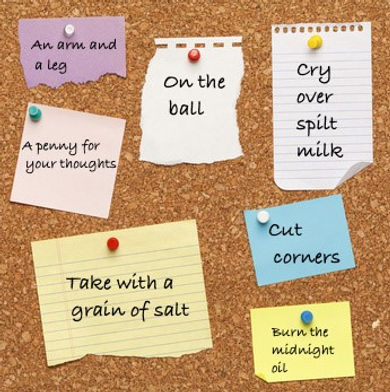
Teachers should teach what students want to learn instead of choosing what to teach (Irujo 1993), therefore we should encourage students to make their own choice! To make teachers less proactive and students more proactive, the setting up an “Idioms Bulletin Board” allows teachers to teach according to students’ preferences.
By setting up the board, students are required to put up idioms they encountered on English-speaking TV shows, songs, newspapers, movies and other possible sources. What they put up on the board will not be graded but instead just to tell their teachers what they are interested in learning. Teachers will then talk about the new idioms on the board every week and gives explanation with daily examples.
The set up of an ‘Idiom Bulletin Board’ in the classroom adopts a student-initiated approach over a "teacher proactive" one. This will be more effective when as it undoubtedly improves the “physical atmosphere of the classroom” to benefit students’ learning (Harmer 2001)
Flashcards
Learn idioms through playing game! All you need is just to prepare a set of carefully chosen flashcards which will not provide excessive or idioms which are not common in daily life. Each card should be clearly printed with an idiom and its meaning on each side, teacher should further evaluate the idioms to enable students to better understand the idiom at the first time.
As Audiolingualism suggests that stimulating students’ response and the repetition with visual aid is important to recall better in the future, repeating the idioms after the teacher every time when the flashcard appears can benefit students’ idioms learning (Law of exercise)(Dakin, 1973). We believe spoken language comes before written language.
Besides repetition, a class can be grouped into pairs and play “mini idioms battle” against each other. The more flashcards an individual remembered with their meanings, will be the winner. Students will surely find it interesting and a good motivation for them to fully understand and remember idioms. It may also slowly turns into a retroactive approach where students will take their own initiative to find out new idioms for making flashcards and battle among themselves, which dictations cannot achieve.

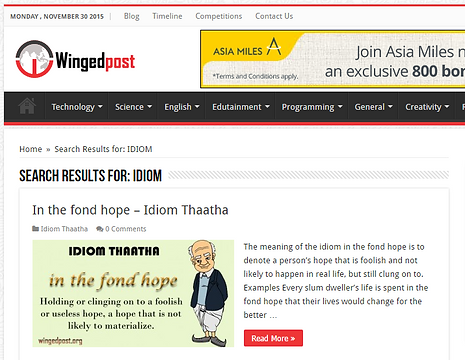
Idiom Thaatha(Winged Post, 2015)

Shhh! idiom (Kaplan, 2015)
More on Video-learning...
Everyday Idioms - made easy
Source from: https://www.youtube.com/watch?v=WVHlVbIgUH0
Idioms: To Break the ice
Source from: https://www.youtube.com/watch?v=Z1sIlfSTYoM
Reference

Brown, T. (n.d.). Teaching approaches: What is audiolingualism? Retrieved November 23, 2015, from http://www.onestopenglish.com/methodology/teaching-articles/teaching-approaches/teaching-approaches-what-is-audiolingualism/146488.article
Ellis, R. (1994). The Study of Second Language Acquisition. Oxford University Press.
Gezer, I., Sen, I., & Alci, B. (2012). The Effect of Peripheral Learning Applied in English Instruction on EnglishIdioms Learning. The International Journal of Education Researchers, 3(3), 19-34. Retrieved November 21, 2015, from http://www.academia.edu/3670662/THE_EFFECT_OF_PERIPHERAL_LEARNING_APPLIED_IN_ENGLISH_INSTRUCTION_ON_ENGLISH_IDIOMS_LEARNING_BY_MEHMET_GEZER
Kaplan (2015). "Shhh! Idiom", Kaplam International Blog. Retreived November 21, 2015, from, http://www.kaplaninternational.com/blog/english-idioms-shhh/
Tran, T.H. (2011). Using Ready-Made Materials for Teaching Idioms. 41st Annual New York State TESOL Conference. Retrieved November 21, 2015, from, http://files.eric.ed.gov/fulltext/ED526846.pdf
Winged Post (2015). IDIOM - Winged Post. Retrieved November 21,2015, from http://wingedpost.org/?s=IDIOM+
